Where Future-Focused Educators Become Builders of Change
The future of education will not be shaped by technology alone. It will be shaped by educators, innovators, and leaders who can transform emerging possibilities into meaningful solutions.
The Innovation Lab is the creative engine of EduNext AI—a space where ideas are challenged, opportunities are explored, and educational innovations take shape.
Here, participants move beyond learning about Artificial Intelligence, instructional design, and innovation. They apply these tools to address authentic educational challenges, design human-centered solutions, and create initiatives with the potential to improve learning, teaching, and educational systems.
Every project in this lab represents a journey of inquiry, creativity, experimentation, and purposeful action. Together, they demonstrate what becomes possible when knowledge is transformed into innovation and innovation is directed toward impact.
Explore the projects, discover the ideas, and meet the innovators who are helping shape the future of education.
Welcome to The Innovation Lab..
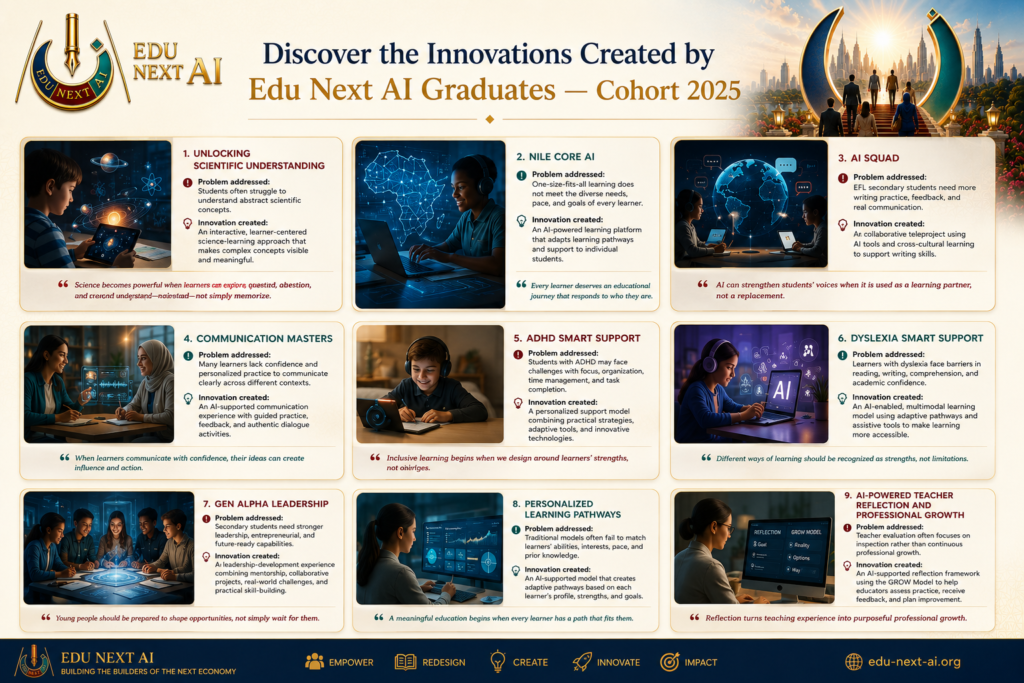
1- Unlocking Scientific Understanding
The Challenge
Scientific concepts are often difficult for learners to grasp because they involve abstract ideas, complex processes, and phenomena that cannot always be directly observed. Traditional approaches to science education may emphasize memorization of facts and formulas, making it challenging for students to develop deep conceptual understanding or connect scientific knowledge to real-world situations.
The Innovation
This project reimagines science learning through a learner-centered approach that combines innovative instructional design, active learning methodologies, and emerging technologies. By creating engaging and interactive learning experiences, the project helps students visualize complex concepts, explore scientific ideas through inquiry, and actively construct their own understanding rather than passively receiving information.
The Potential Impact
By making science more accessible, relevant, and engaging, the project has the potential to improve student achievement, strengthen critical thinking and problem-solving skills, and increase learners’ confidence in exploring scientific concepts. It also supports the development of scientifically literate individuals who can apply their knowledge to address real-world challenges and make informed decisions in a rapidly evolving society.
Why It Matters
When students truly understand science—not just memorize it—they develop the curiosity, analytical thinking, and innovation mindset needed to navigate and shape the future.
2-Nile Core AI
The Challenge
Learners often have diverse needs, learning styles, and academic goals, yet traditional educational approaches frequently provide the same learning experience for all students. This can result in varying levels of engagement, unmet learning needs, and missed opportunities for students to reach their full potential.
The Innovation
Nile Core AI is an innovative learning platform developed by a participant from Botswana to deliver personalized and engaging educational experiences through the power of Artificial Intelligence. By adapting learning pathways, providing tailored support, and responding to individual learner needs, the platform creates a more responsive and student-centered learning environment that promotes meaningful and effective learning.
The Potential Impact
The platform has the potential to increase student engagement, improve learning outcomes, and support learners in achieving their academic goals through personalized guidance and adaptive learning experiences. It also demonstrates how AI can be used to create more inclusive and equitable educational opportunities by meeting learners where they are and helping them progress at their own pace.
Why It Matters
Every learner is unique. When education adapts to the needs of the learner rather than requiring the learner to adapt to the system, learning becomes more engaging, effective, and empowering.
3-AI Squad
The Challenge
Many secondary-stage students learning English as a Foreign Language (EFL) struggle to develop strong writing skills due to limited opportunities for practice, individualized feedback, and authentic communication experiences. As writing becomes an increasingly important skill in academic, professional, and digital environments, educators face the challenge of helping students improve both their language proficiency and confidence as writers.
The Innovation
AI Squad is a collaborative teleproject that leverages Artificial Intelligence and cross-cultural collaboration to transform the way students develop their writing skills. Through the thoughtful integration of AI-powered tools, students receive support in drafting, revising, and refining their work while engaging in authentic learning experiences that encourage creativity, communication, and collaboration. The project positions AI not as a replacement for learning, but as a partner that enhances the writing process and supports student growth.
The Potential Impact
The project has the potential to strengthen students’ English writing proficiency, improve their ability to communicate effectively, and foster greater confidence in expressing ideas. It also helps learners develop essential future-ready skills, including digital literacy, critical thinking, collaboration, and responsible use of Artificial Intelligence in learning.
Why It Matters
In a world where communication and AI literacy are becoming essential skills, students need opportunities to learn how to write with clarity, creativity, and confidence while using technology responsibly to amplify their voices.
4-Communication Masters
The Challenge
Effective communication is one of the most important skills for success in education, the workplace, and everyday life. However, many learners struggle with expressing their ideas clearly, building confidence in speaking and writing, and adapting their communication to different audiences and contexts. Traditional learning environments may not always provide the personalized practice and feedback needed to develop these essential skills.
The Innovation
Communication Masters leverages Artificial Intelligence to create engaging and personalized learning experiences that support the development of communication skills. By combining AI-powered feedback, guided practice, and authentic communication activities, the project helps learners strengthen their ability to articulate ideas, engage in meaningful dialogue, and communicate with greater clarity and confidence across a variety of settings.
The Potential Impact
The project has the potential to enhance learners’ communication competence, boost self-confidence, and improve their ability to collaborate, present ideas, and build meaningful connections. It also equips participants with critical future-ready skills that are increasingly valued in academic, professional, and leadership environments.
Why It Matters
Strong communication turns knowledge into influence, ideas into action, and collaboration into impact. When learners can communicate with confidence and purpose, they are better prepared to thrive in a connected and rapidly changing world.
5-ADHD Smart Support
The Challenge
Students with Attention-Deficit/Hyperactivity Disorder (ADHD) often encounter barriers that can affect their learning experience, including difficulties with attention, organization, time management, and task completion. Despite their many strengths and capabilities, these learners may not always receive the personalized support and adaptive strategies needed to help them succeed in traditional educational settings.
The Innovation
ADHD Smart Support is designed to empower students with ADHD through a combination of personalized learning strategies, supportive tools, and innovative technologies. By addressing individual learning needs and providing practical mechanisms for improving focus, organization, and engagement, the project creates a more inclusive and supportive learning environment that helps students build on their strengths and overcome common learning challenges.
The Potential Impact
The project has the potential to improve academic performance, increase learner engagement, strengthen self-confidence, and support greater independence in learning. It also promotes a more inclusive approach to education by recognizing neurodiversity and providing students with the tools and support they need to reach their full potential.
Why It Matters
Every learner deserves the opportunity to succeed in a way that respects their unique strengths and needs. When students with ADHD receive the right support, they can move beyond barriers, unlock their potential, and thrive as confident and capable learners.
6-Dyslexia Smart Support
The Challenge
Dyslexia can create significant barriers to learning, affecting reading fluency, spelling, writing, comprehension, information processing, and overall academic confidence. Many learners with dyslexia face difficulties in traditional educational environments that are not designed to accommodate diverse learning needs, which can lead to frustration, disengagement, and reduced opportunities for academic success.
The Innovation
Dyslexia Smart Support combines learner-centered instructional design with the power of Artificial Intelligence to create accessible, personalized, and inclusive learning experiences. Through AI-powered tools, adaptive learning pathways, multimodal content, and assistive technologies, the project enables students to access information in ways that align with their individual strengths and learning preferences. By tailoring support to each learner’s needs, the project helps create a more responsive and empowering educational experience.
The Potential Impact
The project has the potential to strengthen literacy skills, increase learner engagement, improve academic performance, and enhance self-confidence among students with dyslexia. It also supports more inclusive educational practices by reducing learning barriers and ensuring that learners have equitable opportunities to succeed and participate fully in the learning process.
Why It Matters
Learning differences should never limit learning opportunities. When education is designed to recognize and support diverse ways of learning, students with dyslexia can transform challenges into strengths and achieve their full potential with confidence and success.
7-Gen Alpha Leadership
The Challenge
Today’s students are preparing for a future defined by rapid technological change, evolving career pathways, and increasingly complex global challenges. While academic knowledge remains important, many learners need greater opportunities to develop the leadership, entrepreneurial, and future-ready skills required to navigate higher education, the workforce, and a rapidly changing world with confidence and adaptability.
The Innovation
Gen Alpha Leadership is designed to equip secondary school students with the mindset, skills, and experiences needed to become effective leaders and changemakers. Through innovative learning experiences, mentorship opportunities, collaborative projects, and real-world challenges, the program helps learners strengthen communication, collaboration, critical thinking, problem-solving, and leadership capabilities. By combining personal development with practical application, the project prepares students to take initiative, embrace innovation, and create meaningful impact in their communities and beyond.
The Potential Impact
The project has the potential to increase student confidence, strengthen leadership capacity, and improve readiness for higher education and future careers. It also helps learners develop an entrepreneurial mindset that encourages resilience, adaptability, creativity, and lifelong learning—qualities that are increasingly essential for success in the 21st century.
Why It Matters
The future belongs to those who can lead, innovate, and adapt. By empowering young people with the skills and mindset to shape opportunities rather than simply respond to them, Gen Alpha Leadership helps cultivate the next generation of leaders, innovators, and changemakers.
8-Personalized Learning Pathways
The Challenge
Learners enter the classroom with diverse backgrounds, abilities, interests, learning preferences, and levels of prior knowledge. Traditional one-size-fits-all approaches often struggle to address these differences, leaving some learners unsupported, others insufficiently challenged, and many unable to learn at a pace that best suits their needs.
The Innovation
This project harnesses the power of Artificial Intelligence and learner-centered instructional design to create personalized learning experiences that adapt to each learner’s unique profile. Through customized learning pathways, adaptive support, and responsive learning opportunities, the project enables students to progress according to their individual learning levels, pace, strengths, and goals. By placing the learner at the center of the educational experience, it creates a more flexible, engaging, and effective approach to learning.
The Potential Impact
The project has the potential to improve learner engagement, increase academic achievement, strengthen motivation, and support greater learner autonomy. By providing personalized guidance and targeted interventions, it helps ensure that every student receives the support they need to succeed while maximizing their individual potential.
Why It Matters
Every learner’s journey is different. When education adapts to the needs of the learner rather than expecting all learners to follow the same path, learning becomes more inclusive, meaningful, and empowering, allowing every student the opportunity to thrive.
9-AI-Powered Teacher Reflection and Professional Growth
The Challenge
Traditional teacher evaluation systems often prioritize performance measurement and accountability over professional growth and continuous improvement. As a result, educators may have limited opportunities for meaningful self-reflection, personalized feedback, and targeted professional development that supports long-term instructional excellence.
The Innovation
This project reimagines teacher evaluation as a catalyst for growth by integrating Artificial Intelligence with the GROW Model of Instructional Design. Through AI-supported self-assessment, structured reflection, and evidence-based feedback, the initiative enables educators to analyze their teaching practices, identify strengths, address areas for development, and explore innovative instructional strategies. The project transforms evaluation from a periodic assessment process into an ongoing journey of professional learning and improvement.
The Potential Impact
The project has the potential to enhance teaching quality, strengthen professional autonomy, and support data-informed decision-making among teachers, evaluators, and school leaders. By fostering reflective practice and continuous learning, it contributes to improved classroom experiences, more effective instructional approaches, and a stronger culture of excellence across educational institutions.
Why It Matters
Great teaching grows through reflection, feedback, and continuous learning. When evaluation becomes a tool for empowerment rather than inspection, educators are better equipped to innovate, refine their practice, and create meaningful learning experiences that positively impact every student.